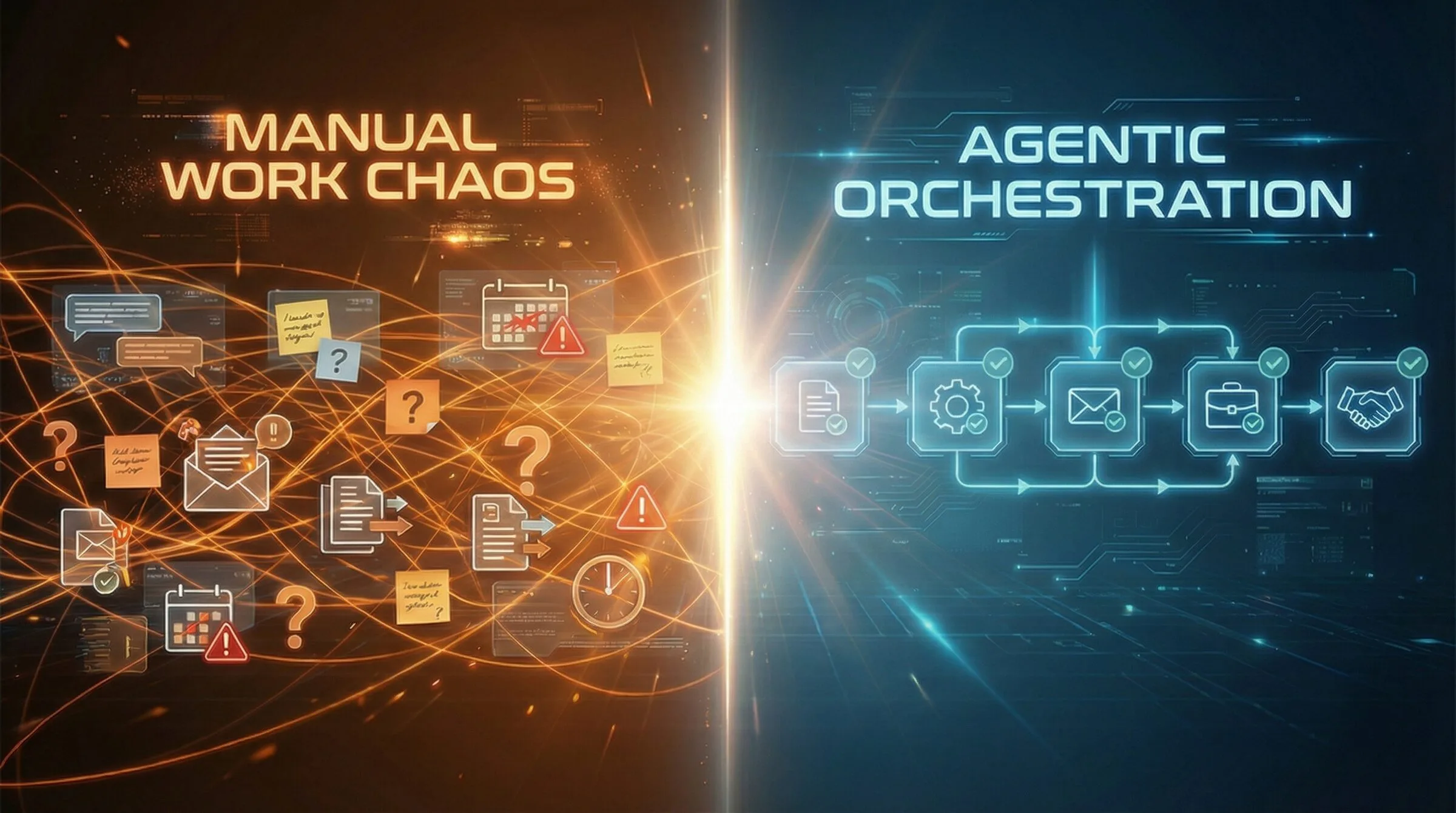
From System of Record to System of Decision
For the last decade, enterprise data teams have done one thing extremely well: stored and governed data. Snowflake, Databricks, BigQuery, the lakehouse, the modern CDP it all works. Your Systems of Record (PMS, CRM, ERP, booking engines) capture what happened. Your Systems of Knowledge (Notion, Slack, Confluence) capture what people know.
Now AI agents are everywhere bookings, pricing, support, marketing and most of them are making decisions in silos, with no shared context and no memory of what worked.
The gap isn’t in the data. The gap is that your stack has never had a layer whose job is decisions.
Systems of Record Are Not Enough
A row in your PMS tells you the room was booked at £220. A row in your CRM tells you the customer churned eight weeks later. Neither row knows that your revenue agent chose £220 over £260 specifically because another agent had flagged the guest as margin-sensitive.
That context the decision, the alternatives, the rationale, the outcome never gets persisted. It lives in a prompt, a log line, maybe a Slack message, and then it’s gone.
When the next agent runs tomorrow, it reads the same Systems of Record your last agent did. It has no idea what decisions were taken, what worked, what didn’t. It can only guess again.
The Decision Execution Layer
The agentic enterprises pulling ahead in 2026 are the ones building a new layer on top of existing systems. We call it the Decision Execution Layer.
It has three properties:
- It sits between Systems of Record and your user-facing agents it doesn’t replace anything.
- It carries a shared Context Object on every interaction: Entities, State, Decisions, Outcomes.
- It enforces guardrails before agents act brand, margin, policy, risk and writes every decision back for the next agent to read.
In effect, it turns your existing stack from a System of Record into a System of Decision.
What Compounds When Decisions Are a First-Class Citizen
Think about what your operation looks like today, decision by decision:
- A revenue management agent chose to discount the last 20 rooms at 9pm.
- A service-recovery agent chose to upgrade a complaining guest instead of refunding.
- A marketing agent chose to push a creator activation in Germany before the US.
- A claims agent chose to auto-approve a £480 claim instead of escalating.
Each of those is a decision with a measurable outcome. In most enterprises today, the outcome is stored somewhere, but the decision that produced it isn’t joined to it. You can’t ask “what kind of discount, on what kind of guest, at what occupancy, moved revenue without eroding margin?” Not cleanly. Not in a way an agent can query at 3am.
Once you make decisions first-class tracked, linked to their outcomes, governed by policy the answers become reusable. Every new agent gets smarter because its inputs include the full decision history of everything the enterprise has tried.
Why SaaS Alone Doesn’t Fix This
It’s tempting to assume a vendor will deliver this. They won’t, because they can’t. Your PMS doesn’t know what your marketing agent decided. Your CRM doesn’t know what your revenue agent chose. The decision layer is by definition cross-system and it only works if it reaches across everything your agents touch.
SaaS keeps earning. But SaaS alone is re-bundling around AI use cases, and shallow, single-app deployments keep failing for the same reason: no shared decision layer, no compounding memory.
How to Tell If You Need One
If any of these are true, you’re running Systems of Record without a System of Decision:
- Your agents contradict each other across customer journeys.
- New agents don’t get better just because older agents ran yesterday.
- Your brand, margin, and policy guardrails live inside agent prompts.
- You can audit what an agent said but not what it decided and whether that decision worked.
- Service recovery, upsell and pricing feel like they’re optimised in separate universes.
The fix isn’t another agent. It’s a layer under all of them.
Closing Thought
Your data stack solved storage and governance. It was never designed to solve decisions.
The enterprises moving from experiment to advantage in 2026 are the ones treating decisions as a first-class asset captured, linked to outcomes, governed at the layer, reusable by every agent.
That’s the move from System of Record to System of Decision. At lemongrass.dev, that’s the layer we build.