Agentification of SaaS in the Near Term: A Roadmap for Travel Enterprises
In the current landscape of travel technology, AI agents are ubiquitous. Companies have rapidly deployed them across booking flows, customer support, dynamic pricing, and marketing. However, speed without context often leads to errors. Most existing systems operate in silos, lacking shared context, memory of past interactions, or a feedback loop from actual outcomes.
The next evolution of the SaaS ecosystem for travel is the transition from simple data movement to a Decision Execution Layer led by various agents.
1. The Missing Link: Decision Memory
While modern data stacks (like Snowflake) are excellent at storing, governing, and finding data, they fail to answer a critical business question: “What decisions did we take, what worked, and what should we do next?”. Without this missing piece agents will make wrong decisions.
Travel enterprises must move toward a model where every interaction is treated as a Context Object. This object moves beyond metadata to create “decision memory” by linking:
- Entities: Customers, bookings, flights, or hotels.
- State: Real-time data pulled from across all business systems.
- Decisions: The specific action taken by an agent or system.
- Outcomes: The final result, which is then fed back to improve future decisions.
2. A New Architecture for Travel SaaS
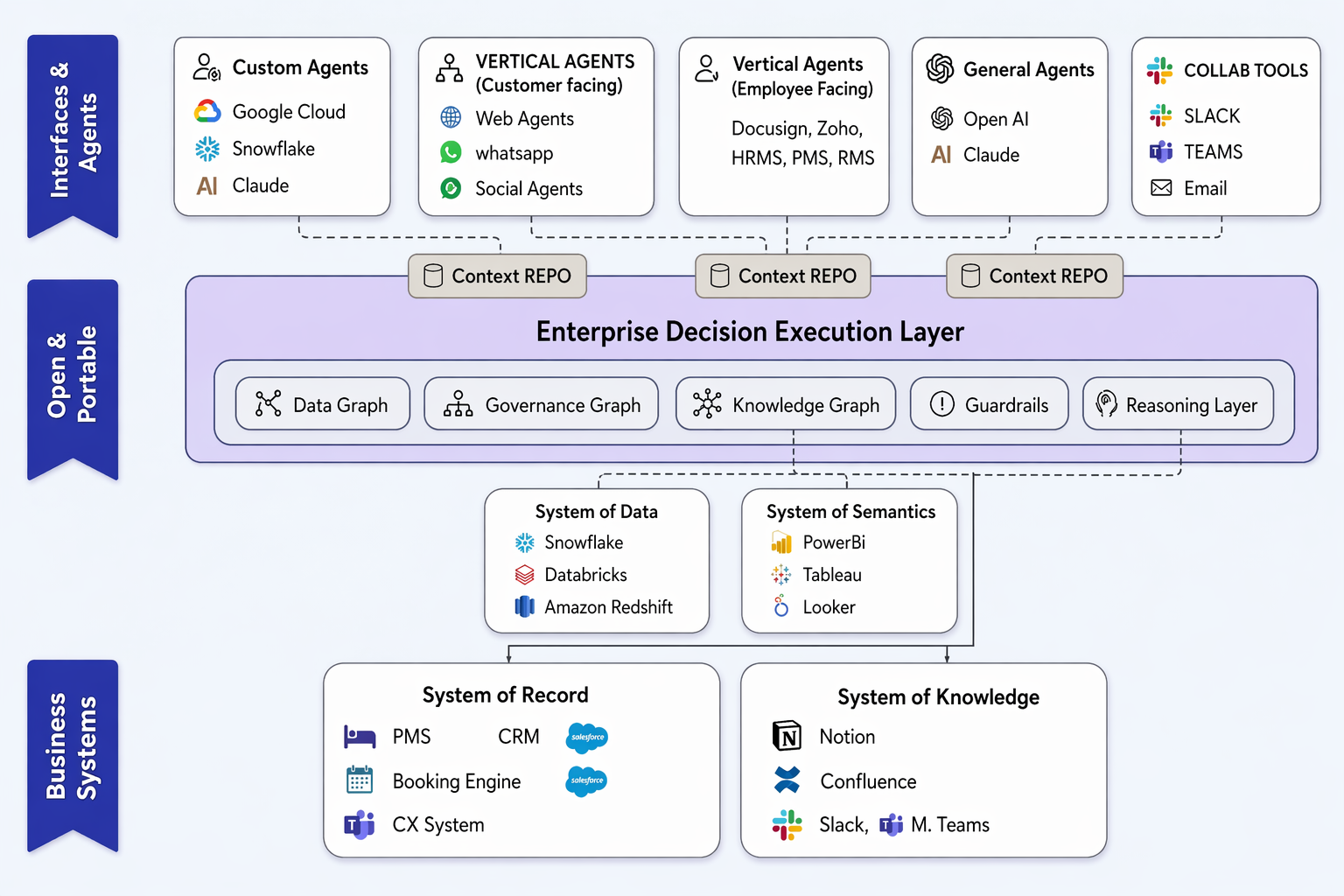
The roadmap for “agentifying” the enterprise involves inserting an Enterprise Decision Execution Layer between your core business systems and your user-facing agents.
The Layered Approach
- Business Systems: Maintaining existing Systems of Record (PMS, CRM, Booking Engines) and Systems of Knowledge (Notion, Slack, Confluence).
- The Execution Layer: Utilizing Data, Governance, and Knowledge Graphs to provide a reasoning layer with built-in guardrails.
- Interfaces & Agents: Deploying specialized agents (Vertical Agents for customers/employees, Custom Agents, and General Agents) that all pull from a unified Context Repo.
3. Near-Term Use Cases and Impact
Implementing a decision-aware framework transforms standard travel operations from rule-based transactions into optimized business decisions.
| Stage | Pre AI Approach | Agentified Approach (with Decision Layer) | Impacted Application |
|---|---|---|---|
| Discovery | Lists available flights/hotels | Prioritized and personalized recommendations | Brand Website, GDS, Channel Manager |
| Pricing | Static or rule-based pricing | Dynamic, margin-aware adjustments | Revenue Management System |
| Booking | Simple transaction processing | Logs decision context for future learning | Booking Engine, Channel Manager |
| Rescheduling | Hardcoded policy enforcement | Decision optimized based on customer value/churn risk | CM, PMS |
| CX | Static performance | Continuous improvement via outcome tracking | CX, OTAs, GMB |
Key Operational Improvements
- Revenue Management: Beyond simple price cuts, agents can learn when discounting works and when it unnecessarily erodes margins.
- Hyper-Personalized Upselling: Identifying not just what to upsell (upgrades, transfers, insurance), but the specific timing that maximizes the likelihood of conversion.
- Service Recovery: Automatically escalating high-risk negative reviews to managers while handling low-impact issues with automated, brand-consistent responses.
4. Architecture
In nearterm SaaS products will remain in the system but would require re bundling to align with evolving AI usecases.
Slim/shallow use cases in individual applications would fail eventually. An enterprise wide approach would be adopted.
5. Building the “Decision Moat”
The ultimate goal of this roadmap is to create a proprietary feedback loop. Every booking, every upsell, and every marketing campaign contributes to a compounding history of decisions.
By moving from a “System of Record” to a “System of Decision,” travel enterprises create a competitive advantage that simple data tools cannot replicatea system that doesn't just know what happened, but understands why it worked and how to do it better the next time.
Are you currently looking to unify your existing AI agents, or are you in the earlier stages of deploying your first vertical-specific agents?